You have three games in eight days. Wednesday night away in Europe, Saturday at home, the following Tuesday away again domestically. Your recovery protocols exist, and your staff know what works, as the plan was written weeks ago.
The problem starts on the bus to the airport. The cold-water immersion unit and recovery suite are at the training ground. Half the equipment that makes your protocols work is bolted to a room your squad will not see again until Friday. What travels is a physio bag, a set of compression garments, and a hotel conference room with bikes lined up against the wall.
The plan does not change, but your ability to deliver it does. In soccer, the weeks when delivery matters most are always the weeks when conditions are tightest.
How congested fixtures affect squad recovery
For some players, the season includes 60 to 80 competitive matches. The number of weeks with at least two games, and a recovery window of 48 to 72 hours between them, is not an exception. It is the rhythm of a competitive season. Every S&C coach managing that schedule understands the consequence: the eccentric loading, the repeated accelerations and decelerations, and the muscle damage profile of match play do not resolve in time for the next fixture.
The question is not whether recovery should happen between those fixtures. It is what can be realistically delivered when the team is on the road, the turnaround is short, and the staff are stretched.

Why recovery interventions fail on the road
Every S&C coach has experienced this. The protocol that works well in a controlled training facility becomes harder to deliver the moment conditions tighten. Dedicated recovery sessions need scheduling around travel and team obligations. Equipment-dependent interventions need setup, supervision, and space that a hotel does not offer. Protocols requiring individual calibration need time and staffing that a congested week does not have.
What survives is what is already embedded. The bike flush after the game happens because bikes are set up wherever the team goes. Active recovery the following day happens because it is part of the routine. Compression garments travel because athletes carry them. These sessions are protected even when everything else gets cut, and they are the recovery that actually gets delivered.
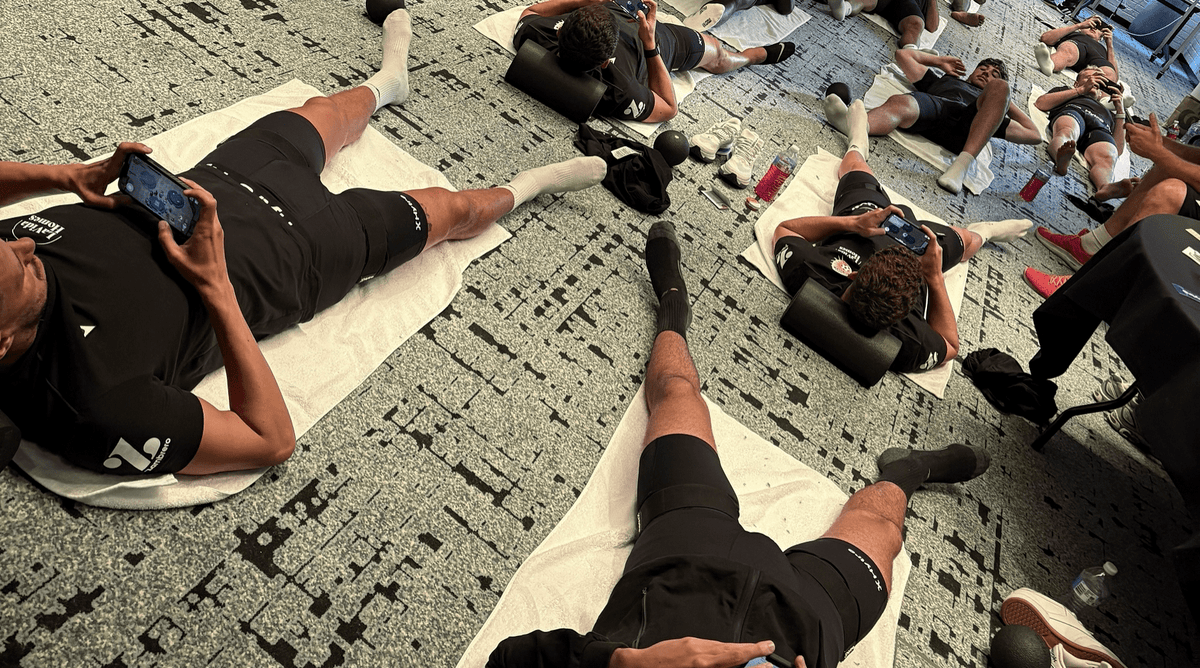
But on the bus after a Wednesday night game, even those sessions are not happening. Compression garments are passive, and there are no bikes, no facility, no active intervention of any kind. The hours between full-time and arrival back at the training ground are dead time, physiologically speaking. Staff know those hours matter, and until now there has been nothing they can do about them.
Blood Flow Restriction and recovery in soccer players
Daab et al. (2021) examined the effect of intermittent blood flow manipulation on recovery following a simulated soccer match in soccer players. Brief cycles of lower-limb occlusion, applied immediately post-exercise with athletes at rest, attenuated the decline in squat jump, countermovement jump, maximal voluntary contraction, and sprint performance across the 72-hour recovery period. Muscle damage markers, creatine kinase and lactate dehydrogenase, were lower in the treatment condition. Perceived muscle soreness was also reduced, both immediately and at 24 hours.
The findings matter for two reasons. First, the protocol used a simulated soccer match designed to replicate the specific physical demands of competitive play: the intermittent sprinting, the direction changes, the eccentric loading that causes the damage profile coaches manage every week. Second, the recovery response was accelerated across the markers that S&C coaches actually track when making availability decisions. Jump performance, sprint performance, and soreness are not abstract measures. They are the data points that determine whether a player is available for a Saturday fixture after a Wednesday night game.
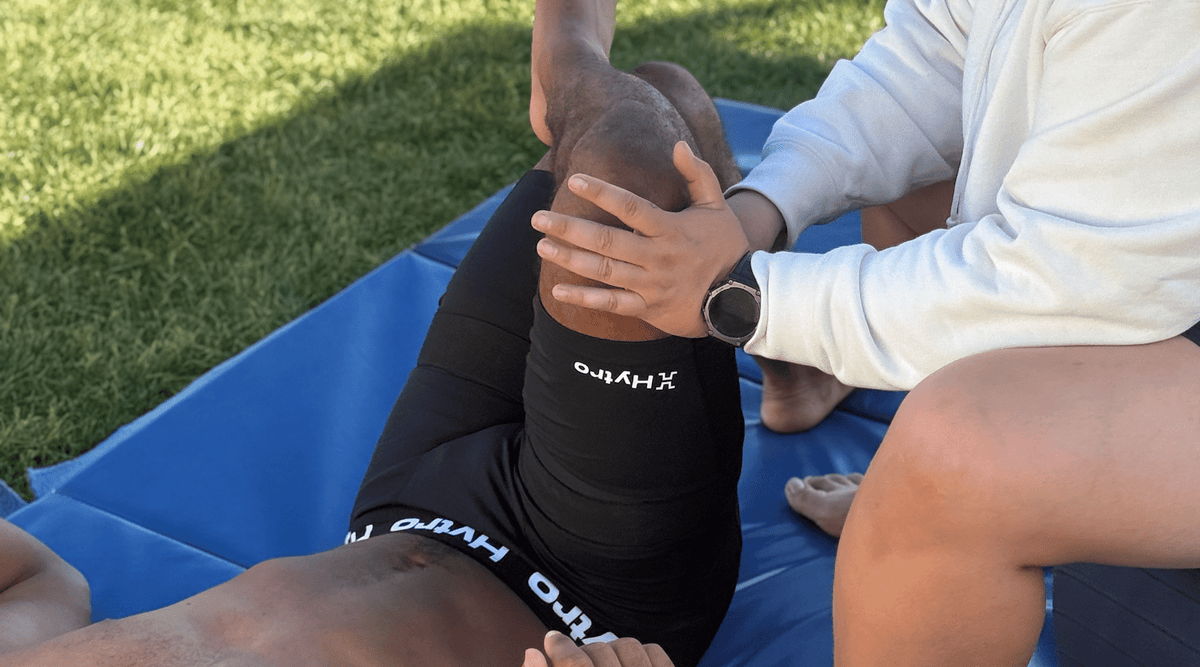
Importantly, the occlusion protocol in Daab et al. was applied at rest. The intermittent cycles of restriction and reperfusion were the intervention, not a combination with activity. The vascular stimulus does not require a bike or a facility. It requires brief, repeated cycles of blood flow manipulation, and that can happen in a seat.
Arriel et al. (2018) showed a similar protective effect over a 24-hour window: after a maximal effort in trained cyclists, cyclic occlusion maintained performance the following day, while both sham groups showed a significant drop. For an S&C coach managing a Wednesday-to-Saturday turnaround, the 24-hour window is not a research abstraction. It is the difference between a player being available and a player being managed around a deficit.
Research from SC Braga has extended this further, examining what happens when intermittent Blood Flow Restriction is applied during a standard low-intensity bike flush, the recovery session that is already scheduled after competition. The findings showed faster restoration of neuromuscular function, reduced soreness, and improved perceptions of recovery. The session stayed the same but the physiological return from it increased.
Together, these findings support two distinct applications: enhancing recovery sessions that are already programmed, and creating a recovery stimulus in contexts where none has previously been possible.

Wearable Blood Flow Restriction for away fixtures and travel
For an S&C coach managing a congested block, the question is not just whether recovery can be improved at the training ground. It is whether recovery can happen at all during the hours when the squad is in transit.
On the bus after a Wednesday night away fixture, no active recovery intervention is being delivered. Those hours between full-time and arrival back at the facility are the gap in every recovery plan, and until now that gap had no practical solution.
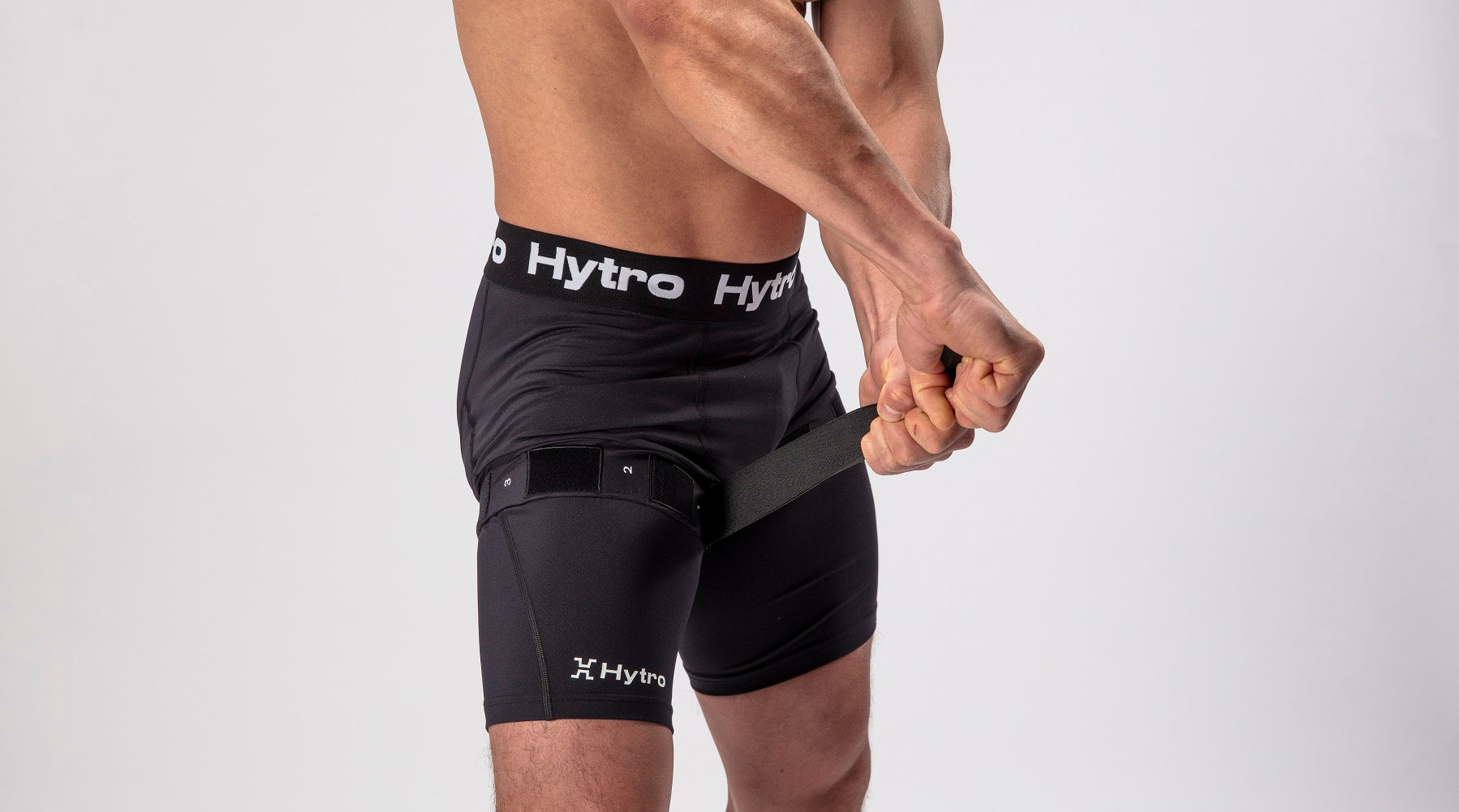
Hytro changes that. A BFR wearable that athletes put on themselves, requiring no machine, no external power, no supervision beyond the initial instruction. Intermittent Blood Flow Restriction applied at rest, in a seat, on a bus or a plane, delivering the same cyclical vascular stimulus that Daab et al. (2021) demonstrated accelerates recovery in soccer players. This is not just an add-on to recovery that is already happening. On a bus at midnight, no recovery is happening, and with Hytro on, it is.
That is a fundamentally different proposition from an intervention that works well in a controlled environment but cannot leave the building. The congested block, the away fixture, the short turnaround with travel in between: those are the weeks when recovery execution fails, and they are the weeks when Hytro matters most.
Recovery beyond the training ground
The bike flush after a game is protected time, and the evidence supports enhancing it with intermittent Blood Flow Restriction. The research at SC Braga demonstrates that. But the bigger opportunity for S&C coaches managing congested fixture blocks is the time that has previously been written off entirely: the bus, the plane, the hotel before bed. Hours when athletes are seated, still, and available, but where no active recovery has ever been delivered.
With a wearable that provides intermittent Blood Flow Restriction without a machine, without power, and without supervision, those hours become physiologically productive for the first time.
International football programmes, including England, have embedded Hytro into their recovery work. We built it for the weeks when your schedule is tightest, your facilities are most limited, and the gap between what you planned and what you can deliver is widest. Not just to improve the recovery you are already doing, but to create recovery where none existed before.
Get the soccer periodisation guide
Want to take it further?
References
Arriel, R.A., de Souza, H.L.R., da Mota, G.R., & Marocolo, M. (2018). Declines in exercise performance are prevented 24 hours after post-exercise ischemic conditioning in amateur cyclists. PLoS One, 13(11), e0207053. https://doi.org/10.1371/journal.pone.0207053
Daab, W., Bouzid, M.A., Lajri, M., Bouchiba, M., & Rebai, H. (2021). Brief cycles of lower-limb occlusion accelerate recovery kinetics in soccer players. The Physician and Sportsmedicine, 49(2), 143-150. https://doi.org/10.1080/00913847.2020.1785260