

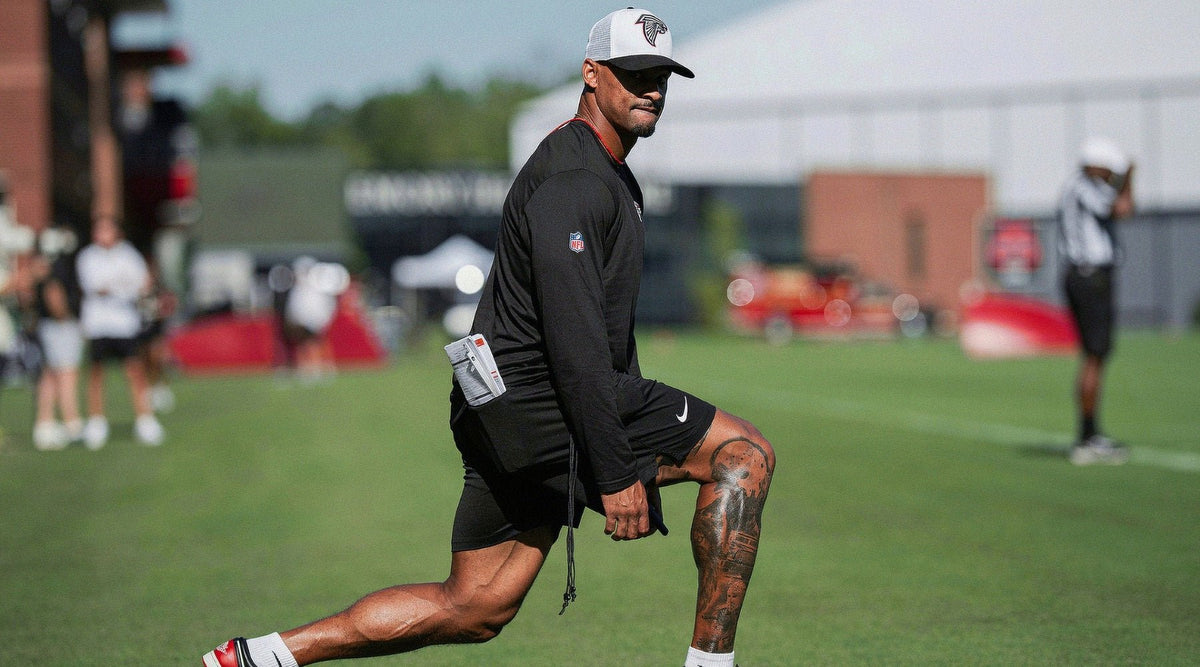
The weeks between training camp and opening day are among the most physically consequential in the NFL calendar. John Griffin, Director of Player Performance at the Atlanta Falcons, explains how the best performance departments navigate them.
Training camp does not build NFL players. By the time veterans report in late July, they arrive conditioned. What camp does is expose them: to heat, to contact, to two-a-days, to the specific demands of football that no amount of offseason conditioning fully replicates. Over five to six weeks, that exposure accumulates. By the time the 53-man roster is set at the end of August, the athletes who make the cut are carrying the physical cost of everything that got them there.
Opening day arrives within days. The transition from maximum-volume camp training to Week 1 game preparation is one of the least-discussed and most consequential challenges in NFL performance. The teams that manage it well arrive at their first regular season fixture with a healthy, fresh, and available roster. Those that do not spend the early weeks of the season managing the consequences.
Managing three different rosters at once
For John Griffin, Director of Player Performance at the Atlanta Falcons, training camp is not a single challenge. It is three simultaneous ones. During camp, the Falcons roster swells to 90 players before being cut to 53. Within that group, Griffin identifies three distinct cohorts that require entirely different performance models.
Established roster players can be trained more aggressively during the week because they are not playing meaningful preseason minutes. Bubble players fighting for selection are effectively already in-season mode, practising and playing in full games every week.
Younger athletes developing their game need a different model again. As Griffin puts it:
"Those at the bottom of the roster are practising and playing in full games every week, so their programme looks more like an in-season model. Meanwhile, guys who are safe on the roster can be trained more aggressively during the week because they are not playing as many minutes in preseason."
Managing those three groups simultaneously, across a 90-man roster, through five weeks of camp, is a logistical and performance challenge that sets the conditions for how the season begins.

The transition problem
The final week of preseason presents a specific challenge. Roster decisions have been made. Players are preparing mentally and physically for the season. But the body does not reset simply because the calendar has moved on. The accumulated load of camp does not clear in a week.
Performance staff are managing a narrow window between the end of meaningful preseason activity and the first regular season kick-off. As Griffin explains, the objective in this window is not to build fitness. There is neither time nor recovery capacity for that. The objective is to reduce accumulated fatigue, restore neuromuscular readiness, and arrive at Week 1 with players who feel sharp, not simply present.
The Falcons' approach is built on pre-emption rather than reaction. Griffin is clear that mid-season improvisation is a sign the system has already failed: "We try to be as pre-emptive as possible. We want to bake recovery into our schedules, create the right waves through the season, and then focus on the five to ten players who might need extra support. If you're making wholesale changes mid-season, the system is already broken."

Efficiency is the non-negotiable
In-season, the NFL week leaves little room for recovery that adds to the schedule rather than fitting inside it. For Griffin, this is a fundamental design constraint that shapes every decision about what goes into the programme and what does not.
The interventions that survive this constraint share a common characteristic: they deliver a meaningful physiological stimulus without adding to the load or time the body is already managing. Griffin frames it directly: "In-season, you don't really have a lot of time to train guys, so you have to be efficient with your time. Having a product like Hytro gives us the flexibility to train the team holistically rather than focusing on individuals. It increases our efficiency throughout the season."
The game day plus one session illustrates this in practice. After every match, the Falcons' priority is restoring range of motion and returning players to what Griffin calls homeostasis: long muscle lengths, reduced inflammation, and a body ready to train again. Restoring blood flow and clearing the metabolic load of the game is what that homeostasis actually depends on, and BFR is central to delivering it. Players use it on the bike, 20 seconds on and 10 seconds off at moderate intensity, driving circulation to fatigued lower limbs without adding mechanical stress. The protocol runs during activity players are already completing rather than requiring a separate session, but the physiological stimulus doesn't depend on what else is happening around it.

The case for scalable recovery
Blood Flow Restriction has been part of Griffin's performance toolkit for several years. The challenge, historically, was deploying it across an NFL roster. Individual cuff-based systems require calibration, supervision, and dedicated setup time that makes squad-wide application impractical. Hytro changed that calculus.
Griffin describes the shift clearly: "We loved the research and the feedback from athletes, but with the old units it just was not possible to deploy at scale. When Hytro came along, it solved the problem. Suddenly we could roll it out to 50 or 90 players at once."
Hytro's Haematec system delivers consistent, validated sub-occlusive pressure at the correct point on the limb, within the proven range of limb occlusion pressure, without requiring individual calibration for each athlete. For a performance department managing the camp-to-season transition across a 53-man roster, this is not a minor operational detail. It determines whether recovery can be delivered consistently across the full squad, or only for the players who have time for an additional session.
For Griffin, simplicity of adoption is as important as the physiological effect: "Simplicity is number one. If it's too complex, it won't stick. Hytro fit straight into our existing framework, and that has been key to adoption."

Availability is the metric that matters
In professional football, the performance conversation always returns to one number: how many players are available on game day. It is a principle Griffin returns to consistently, and one that shapes how the Falcons approach every decision in camp and across the season.
The logic is straightforward. When a key player is unavailable, not injured but carrying enough accumulated fatigue to be limited in preparation, the entire week's work is compromised before it begins. The teams that protect availability through the camp-to-season transition do so by treating the recovery window as a structured process, not a variable that adjusts to the demands of the schedule. As Griffin describes his approach:
"We can design the best templates in the world, but if we don't execute at a high level, it means nothing. Execution is the secret sauce."
When the regular season begins, the teams with the healthiest rosters are not the ones who worked hardest in camp. They are the ones who recovered smartest throughout it, and who built the processes to do so consistently, regardless of where the schedule took them.

Leave a comment
This site is protected by hCaptcha and the hCaptcha Privacy Policy and Terms of Service apply.