
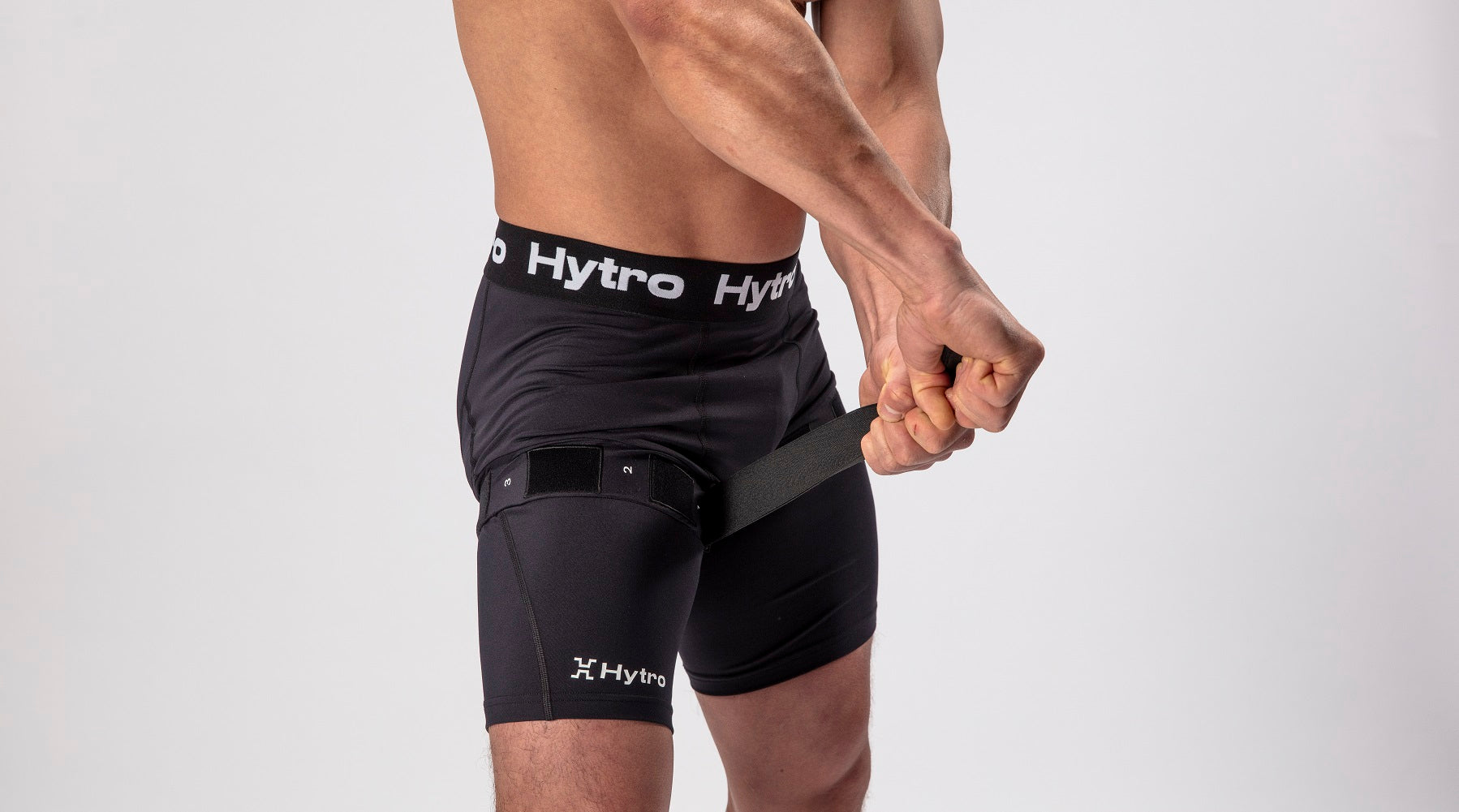

BFR is safe when it's applied properly, and the evidence on that is strong and consistent. It's also far easier to apply properly than it used to be. Much of what once made BFR fiddly- judging pressure by feel and getting placement right on every athlete- has been engineered out by validated wearables. The mechanics are no longer the hard part.
What's left is the part that was always the practitioner's job: knowing who it suits, when to reach for it, how much, and what a normal response looks like. None of it is complicated. But it is the difference between BFR that earns its place in a programme and BFR that gets tried once and left in a bag.
Here’s what safe advocation is underpinned by.
Screening comes first, always
Before pressure, before protocols, before anything, is the question of whether this athlete should be doing BFR at all. Most people are fine. But BFR briefly changes the haemodynamics of a limb, and there are conditions where that matters: a history of blood clots or DVT, clotting disorders, peripheral vascular disease, certain cardiovascular conditions, and uncontrolled hypertension. These are genuine contraindications, not box-ticking. Screening for them, properly and documented, isn’t bureaucracy; it’s the difference between a safe modality and an avoidable incident. If you don’t have a screening process, you don’t have a safe practice, however good everything downstream is.
A well-designed, pressure-validated wearable removes much of the risk that used to come from getting pressure and placement wrong by hand. What it doesn’t change is who should and shouldn’t be doing BFR in the first place. That judgment is about the athlete, not the kit, and it always comes first.

Getting the pressure right without the guesswork
Everything about BFR hinges on the restriction being right: firm enough to pool blood in the working muscle, never so hard that it becomes a limitation to the limb. Get it wrong in either direction, and you’ve either wasted the session or created a problem.
Traditionally, this was the hardest part to control. The clinical route individualises pressure by measuring limb occlusion pressure (the point at which arterial flow to the limb is fully cut off) and working to a percentage of it. It’s precise, but it demands measurement equipment, time and supervision, none of which survive contact with a busy training floor. It’s also where a lot of field BFR quietly went wrong: loose bands pulled to an arbitrary tightness meant the same “pressure” landed completely differently from one athlete, or one session, to the next.
A pressure-validated wearable like Hytro takes a different route to the same safety goal. Rather than asking the practitioner to measure and monitor pressure in real time, the restriction is engineered to sit within a validated safe and effective range and applied through a set, repeatable scale: the same setting delivering the same stimulus, session after session, athlete after athlete. That isn’t a shortcut around the principle; it’s how the principle becomes usable outside a lab.
The question shifts from “what pressure am I applying?” to “what modality and what setting suits this method for this athlete, today?”, which is something a coach can actually answer at scale.
Placement and consistency shouldn’t be left to chance
Two things decide whether safe Blood Flow Restriction does what you intend: where it sits, and whether it’s the same every time.
Placement matters because the restriction belongs at the very top of the limb (high on the thigh or the upper arm), where it occludes the working muscle without getting in the way of movement. Too low and you change the effect entirely. With loose bands or wraps, that’s one more thing to get right on every athlete, every time; a wearable with the mechanism built into the garment takes that variable off the table, positioning the restriction by design rather than by hope.
Consistency matters just as much. BFR only becomes programmable when the same input reliably produces the same stimulus. If your restriction drifts (a little tighter today, looser tomorrow), you can’t compare sessions, can’t progress with any confidence, and can’t be certain you’re inside a safe range. A validated, repeatable setting as delivered by Hytro is what turns BFR from something you feel your way through into something you can actually prescribe.

Load and volume do the work: the wearable just changes the terms
It’s worth being clear that the wearable isn’t the training; it’s what lets low loads behave like heavy ones. BFR is paired with light resistance (typically in the region of 20 to 40% of one-rep max, and often just bodyweight or gentle movement when it’s used for recovery), and it’s the combination of that load, the restriction and the accumulated volume that drives the adaptation.
Understanding that relationship is a safety issue as much as an effectiveness one: it stops practitioners from reaching for a higher setting when the real answer is better programming, and it keeps sessions inside a sensible dose rather than chasing discomfort for its own sake.
Monitor the athlete, and build tolerance gradually
BFR produces a real physiological response, and using it well means knowing what’s normal and what isn’t. Some numbness or tingling, a feeling of tightness, muscle swelling, changes in skin colour, and increased vascularity are all expected and harmless. Heart rate and blood pressure rise, and the muscle fatigues quickly – just like normal high-intensity exercise.
What you’re watching for is anything past that: pain that’s sharp rather than the familiar ache, numbness that doesn’t settle, a limb that doesn’t return to normal once the straps come off. Safe practice means watching the athlete, not just the clock, and building exposure gradually: starting lower on the setting scale and progressing as they adapt, rather than going to the top on day one.

Knowing the rules and applying them are different things
None of this is complicated to state. That’s rather the point, and the trap. It’s easy to read a list like this, feel informed, and underestimate how much of safe BFR lives in the judgement between the lines: reading an athlete’s response, adjusting on the fly, knowing when the textbook answer is the wrong one for the person in front of you.
That competence doesn’t come from a summary. It comes from structured education and supervised practice, which is exactly the gap Hytro Education is built to close, taking practitioners from the fundamentals through to safe, confident application in a real performance environment.
Used well, BFR is one of the most useful tools in performance. “Used well” is doing a lot of work in that sentence, and it’s entirely learnable. It just has to be actually learned.
Reading the fundamentals is the easy part. Hytro Education takes practitioners from these principles through to safe, confident application: screening, getting the pressure right, programming and monitoring, all in a real performance context. If you’re using BFR with athletes, make sure you’ve learned it, not just read about it.



Leave a comment
This site is protected by hCaptcha and the hCaptcha Privacy Policy and Terms of Service apply.