
Inside the Strategies Keeping Players Fresh When It Matters Most
Tournament football compresses a season's recovery challenge into a few weeks: matches every four to five days, knockout rounds stretching into extra time, and travel stacking on top of a full domestic campaign. There is no opportunity to rebuild physical qualities, only to protect them. If footage from England men's recent training camp is anything to go by, with players wearing Blood Flow Restriction (BFR) during recovery sessions, that protection is increasingly active and structured, not left to rest days.
The interventions that survive tournament conditions share three qualities: they deploy in minutes, they travel, and they layer into activity players are already doing.
How do elite teams use BFR between matches? What Hull City's promotion campaign shows
The closest domestic equivalent to tournament congestion is a Championship promotion run: 46 league matches plus cup fixtures, with Saturday-Tuesday turnarounds leaving roughly 72 hours between performances. During Hull City's promotion-winning season, Head of Performance Matt Busby built the recovery model around a single organising principle: freshness.
“The biggest thing for us is freshness. Being ready for every single game,” Busby explains. “Games come thick and fast. For us it is how can we get the players ready, fit, fresh to go again game after game after game.”

Two features of Hull City's approach translate directly to tournament environments.
Recovery starts inside 30 minutes of the final whistle
“Straight after the game, the first thing we do is get the lads on BFR.” Players are typically in Hytro BFR within 30 minutes of full time, allowing the recovery process to begin while the schedule is otherwise occupied with travel and debriefs. As Busby puts it: “Time's a healer, and we don't have time.”
BFR is layered into existing sessions, not added to the schedule
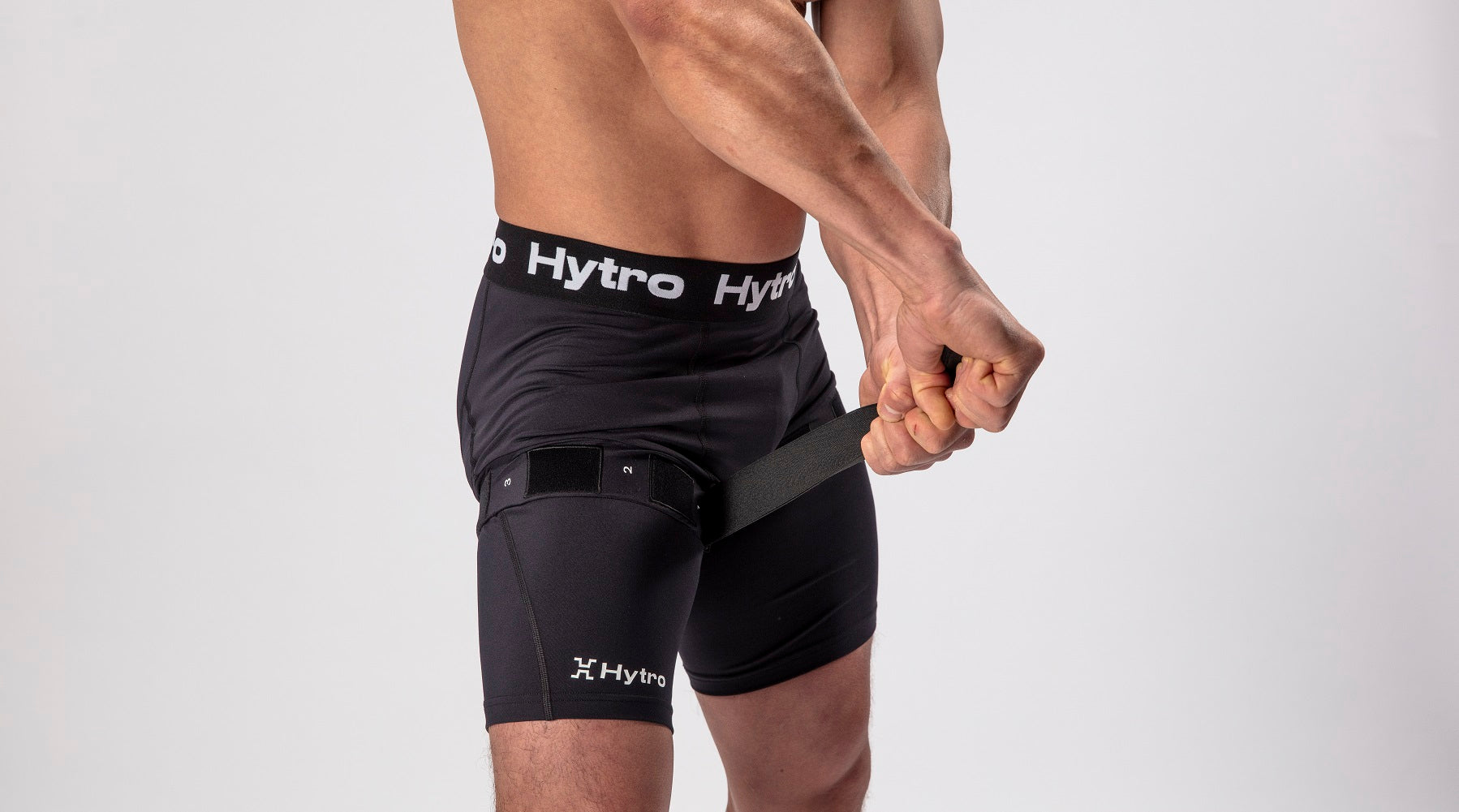
Rather than extending the training day, Hull City deliver a Passive BFR stimulus during work that players are already completing. Following on-pitch active recovery, players wear Hytro BFR Performance Shorts through their mobility and upper-body gym session, using a defined protocol:
• Three sets of five minutes at maximum occlusion
• Two minutes unstrapped between sets
• Delivered alongside the scheduled upper-body session, with no additional time cost
“It's just maximising the sessions whilst they're here,” Busby says. For tournament staff managing packed daily schedules, this integration model, recovery delivered inside existing activity, is arguably the most transferable lesson from Hull City's campaign.
What does active Recovery BFR look like in practice? The bike flush model
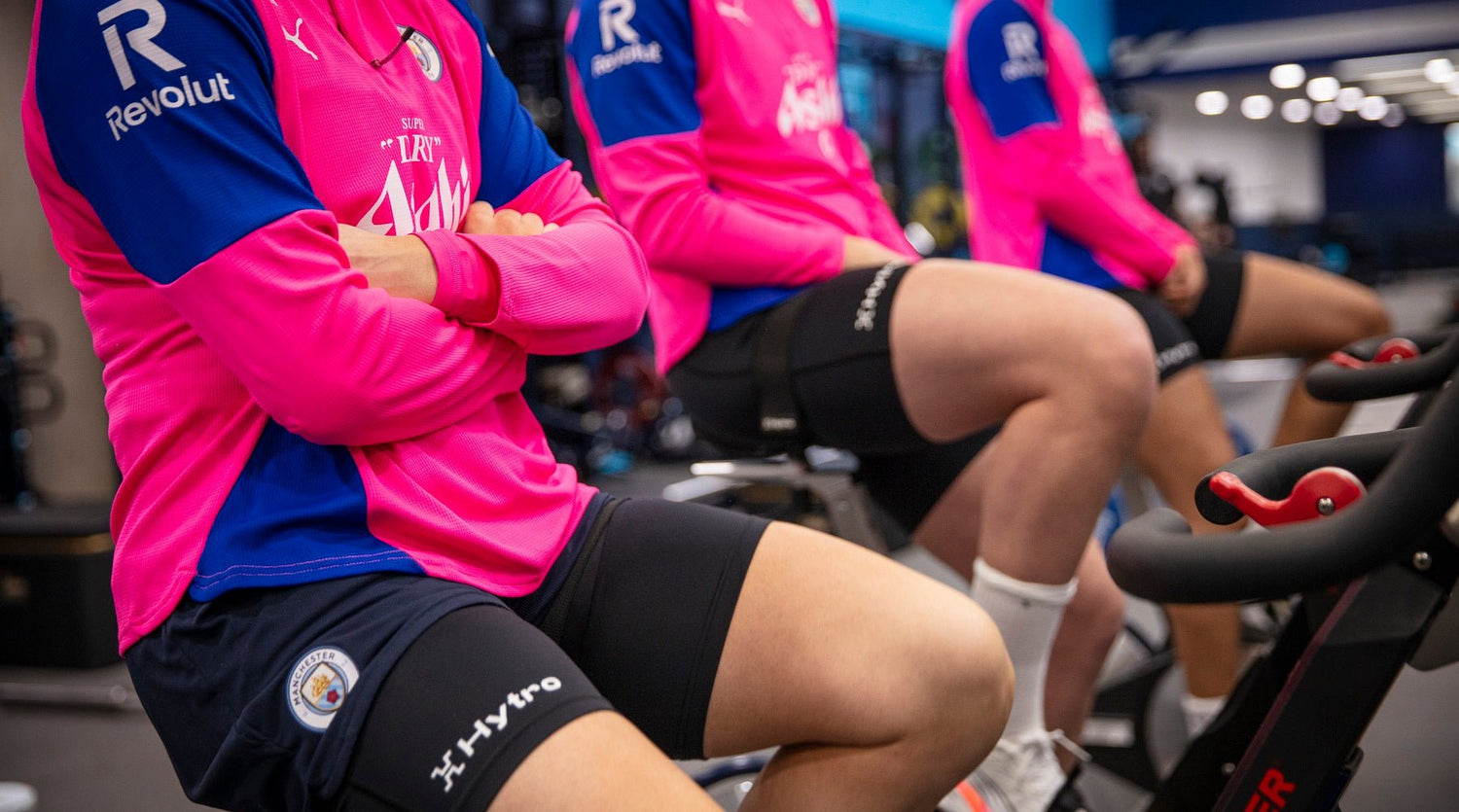
At Manchester City Women's Football Club, recovery sits inside the performance model rather than alongside it. Led by practitioners including Emma Deakin, the approach is individualised and proactive, built on the principle of matching “the modality of recovery to the modality of fatigue.” Players are given a range of options aligned to how they feel and what the fixture demands.
Within that model, one of the most consistent applications is the post-match bike flush: players use BFR actively on the bike after matches, combining low-intensity cycling with the restriction-and-release stimulus to drive circulation through fatigued lower limbs. BFR is also used passively during low-effort recovery and alongside other modalities such as cold-water immersion, without disrupting existing protocols.
Adherence is the quiet advantage here. Because many players have prior exposure to BFR through rehabilitation, it carries trust, and familiarity drives the consistency that ultimately supports performance. As Busby found at Hull City, “players buy into Hytro because it doesn't change what they need to do... It's become the norm.” In tournament camps, where every intervention competes for limited player attention, buy-in of this kind is not a soft benefit. It determines whether a recovery strategy exists in practice or only on paper.

What is Recovery BFR actually doing?
Blood Flow Restriction involves applying pressure to the limbs during low-intensity or passive activity. The mechanism practitioners care about is restriction-and-release: pressure builds in the working muscles, and when the stimulus is removed, the resulting flush of blood supports the removal of inflammation and metabolic byproducts. Research into low-pressure Recovery BFR protocols has demonstrated improvements in circulation and lactate clearance, reductions in perceived muscle soreness, and a positive effect on heart rate variability (HRV), indicating a faster return towards physiological readiness. All of it is achieved without adding mechanical or metabolic load, which is what makes it viable immediately post-match, on recovery days and during travel.
How do players manage travel and recovery in tournament conditions?
Tournaments move. Base camps, match venues and time zones change across the competition, and recovery has to travel with the athlete. The demands are familiar to clubs with extreme travel calendars: at Perth Glory FC, where players can cover 70,000 to 80,000 km in a season with flights of three to eight hours arriving one or two days before matches, BFR is used to stimulate circulation during travel and immediately on arrival, helping players step into match preparation in a better physical state.
The same logic applies inside a tournament: portable, wearable BFR allows the recovery stimulus to be delivered on the bus, at the hotel or in flight, rather than being confined to the training base. Hytro's wearable design requires no pumps, cuffs or staff supervision, and has been validated as safe for unsupervised use, which allows squads to deploy it consistently across changing environments.

What does the England training footage tell us?
Recent publicly available footage from England men's training camp illustrates how normalised this approach has become at the top of the game: recovery technologies are no longer experimental additions but part of the established rhythm of international camps, applied in exactly the windows described above, between matches, inside existing sessions, when the schedule allows nothing extra.
Built for football's biggest moments
Whether the objective is promotion, silverware or international competition, the performance problem is remarkably consistent: keep players fresh, keep players available, and help them perform again within a fixed and unforgiving schedule. The teams that navigate critical periods best are rarely the ones doing more. They are the ones maintaining more, more often, within the constraints of the calendar.
Hytro BFR is designed for exactly this context: deployed within 30 minutes of full-time, layered into sessions players are already completing, and portable enough to travel through every stage of a tournament.
Frequently Asked Questions
How do footballers recover between tournament matches?
Elite squads combine foundational strategies (sleep, nutrition, hydration) with active interventions such as low-intensity flush work, mobility, cold-water immersion and Blood Flow Restriction. Because matches arrive every four to five days, most interventions are integrated into existing activity, post-match bike flushes, travel windows and gym sessions, rather than scheduled separately.
Does BFR improve recovery after matches?
Research into low-pressure Recovery BFR has demonstrated improved circulation and lactate clearance, reduced perceived muscle soreness, and a positive effect on HRV, suggesting a faster return towards physiological readiness. These effects are achieved without adding mechanical load, which is why practitioners deploy it immediately post-match and during congested periods.
How quickly after a match can BFR be used?
Immediately. At Hull City, players are typically wearing Hytro BFR within 30 minutes of the final whistle, using a passive protocol of three five-minute sets at maximum occlusion with two minutes between sets, delivered alongside activity already in the schedule.
Is BFR safe to use during recovery?
When applied according to guidance, BFR is widely used across elite sport. Hytro's wearable BFR is validated as safe for unsupervised use (Neal et al., 2023), allowing squad-wide application without specialist equipment or one-to-one staff oversight.
How is Hytro different from other BFR systems?
Hytro integrates BFR into a wearable garment, removing pumps, cuffs and supervision requirements. That makes it fast to deploy post-match, portable across travel and tournament environments, and easy to layer alongside existing recovery modalities, which is what drives the consistency recovery strategies depend on.


Leave a comment
This site is protected by hCaptcha and the hCaptcha Privacy Policy and Terms of Service apply.