
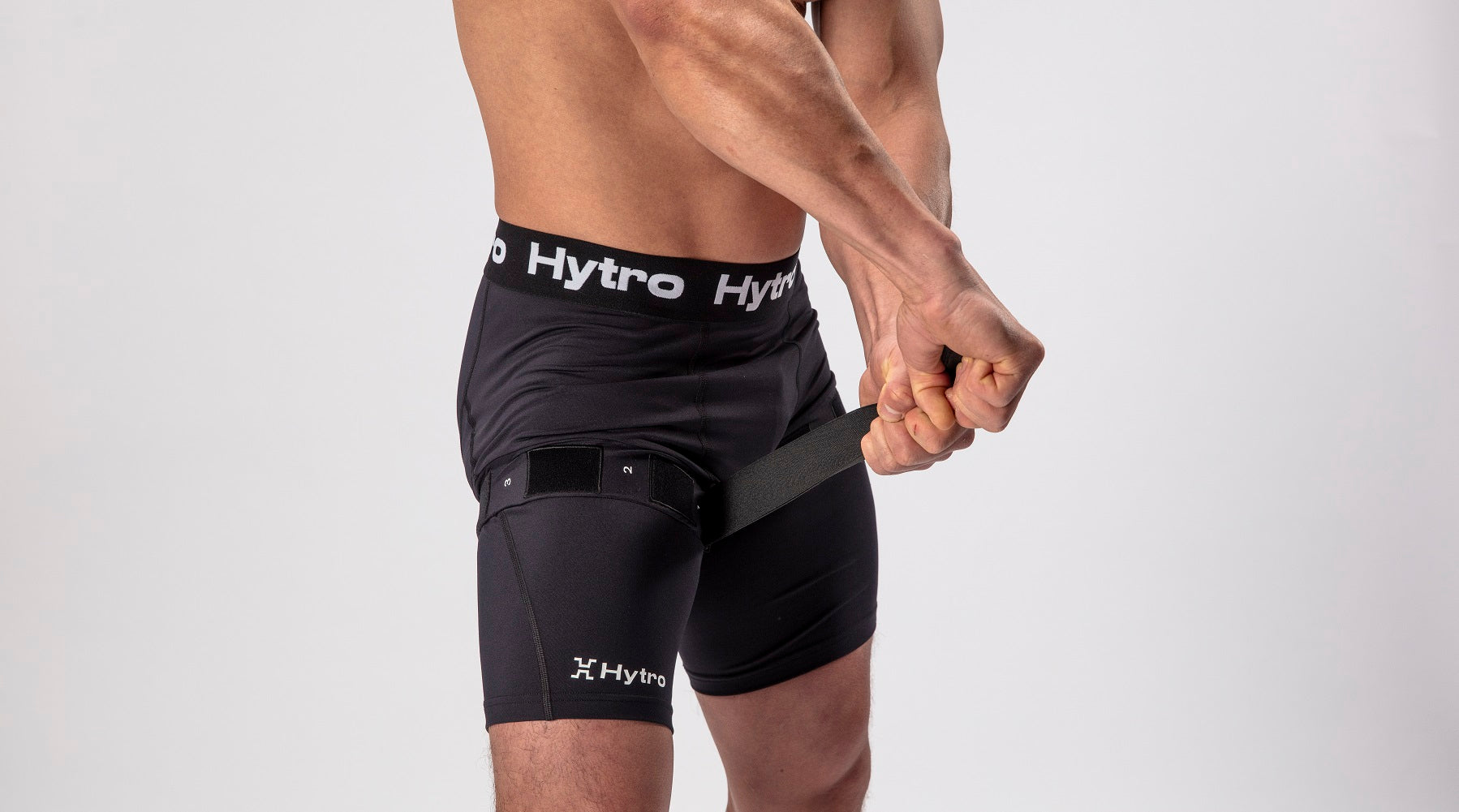

Every innovation starts with curiosity, and for Dr Warren Bradley, that curiosity became the foundation of Hytro.
Warren’s path into performance science began when a chance conversation changed his life. As an undergraduate unsure of his next step, his professor, Graeme L Close, asked if he would consider moving abroad within a week to take on a PhD role with Munster Rugby, one of Europe’s largest professional teams. Warren said yes.
“It was a two-footed dive straight into the deep end,” he remembers. “Straight from undergrad into the workforce. That was the start of sharpening my tools and figuring out who I wanted to become.”
That PhD, in Exercise Physiology and Nutrition, was funded by Munster Rugby and later by England Rugby. It marked the beginning of a career that blended research and applied practice within sports teams, two pillars that would later define Hytro.
Alongside his academic work, Warren spent over a decade working within professional clubs across International and Premiership Rugby, Premier League and Championship Football, and Super League Rugby. He built a reputation not just as a sports scientist, but as a practitioner who embedded himself across the whole team environment. Working across performance, medical, and analysis departments allowed him to explore the gaps between science and real-world practice and first become aware of Blood Flow Restriction.

From curiosity to conviction
At the time, BFR was primarily used to help injured athletes accelerate muscle growth and function during rehabilitation. The results were impressive, but the process was slow and complicated. Equipment was bulky, expensive, and required close supervision.
Warren recognised that BFR’s potential extended far beyond rehabilitation. He saw an opportunity to use it to enhance performance and recovery in healthy athletes, while creating a simpler, safer, and more scalable way to apply it.
He spent months researching academic papers and patents and realised that while the science was there, the delivery was limited. Then, during early-morning commutes, hours of quiet thinking without distraction, an idea began to form.
What if BFR could be built into clothing to make it more accessible? What if we could make it part of a T-shirt or pair of shorts so it was always positioned correctly and safe to use without practitioner supervision?

The more he explored it, the clearer it became. BFR had a scientifically proven, deep physiological influence on the body, and it was totally untapped. By removing the barriers to its application, a more practical BFR device had the potential to reshape how coaches approached performance and recovery across their entire performance programs.
That realisation became an obsession. Warren began sketching designs and, with his partner Claudia, started building prototypes late at night and on weekends on a sewing machine. They bought T-shirts, Velcro, elastic, and metal D-rings from a local fabric shop.
Claudia sewed. Warren refined the concepts. Their spare room filled with ideas, mistakes, and breakthroughs.
“It was a lot of trial and error,” Warren recalls. “We didn’t have the answers at the start, but we were committed to finding them.”
As the prototypes evolved, Warren invested his savings into securing a patent. “I didn’t know what a patent really was,” he laughs. “I just knew I had to protect a valuable idea.” His family loaned him the final amount required. That belief, before there was even a business, would become the heartbeat of Hytro.
The community that shaped the beginning
From the outset, Hytro was shaped through conversation and challenge. Warren drew on a broad network built over years across academic institutions and elite sporting environments. This included researchers, sports scientists, medical staff, coaches, and performance practitioners he had worked alongside in universities, professional clubs, and international programmes.
These conversations were not about validation, but about rigorous, constructive critique. Ideas were challenged, tested, and refined in environments where standards were uncompromising, and evidence mattered. Academic colleagues scrutinised the science, while practitioners anchored those discussions in the practical realities of high-performance sport.
This exchange between research and application became a defining feature. It ensured the product was not built in isolation but shaped by the demands of elite environments. Many of these individuals became early users and contributors, establishing the foundations of the Hytro community.
That approach remains unchanged today, leveraging a large community of professional coaches, athletes and academics. Listening closely, inviting scrutiny, and building alongside those who apply the work every day continue to shape how Hytro evolves.

Where science met leadership
Warren’s work caught the attention of city duo Paul Harter and Raj Thiruchelvarajah.
Paul had spent over three decades as a corporate lawyer, rising to Senior Partner at Gibson Dunn, one of the world’s most prestigious law firms, before following his passion for strength training to found his own business. Raj had built a career across consulting and finance, beginning at a Big Four accountancy firm and culminating in leading complex international change projects. He too chose to leave his city career to follow his passion for sport, fitness and health by joining Paul’s business as the CEO.
Raj and Paul were introduced to Warren by Professor Graeme L Close when they were looking for a sports scientist to work with them on a project. Graeme recommended Warren, and the relationship grew from there.

For Warren, it was about solving a scientific problem. For Raj, it was about taking a science-backed product and building a business that could positively impact millions. “The science was compelling,” says Raj. “But science on its own isn’t enough. The challenge was building something that could stand up to scrutiny, operate at scale, and actually make a difference in the real world.”
For Paul, it was about ensuring the science did not just work, that Hytro could scale, endure, and become a credible, investable business.
Significantly, none of the founders came from sports tech. They had the scientific expertise and decades of experience navigating complex industries, but building a hardware product for elite sport was something entirely new.
Rather than seeing that as a limitation, they made it their advantage. They questioned assumptions, challenged outdated processes and applied first-principles thinking to an industry that often defaulted to familiar routines and legacy systems.
Together, they formed a founding team that combined science and business acumen, driven by a shared commitment to making proven science accessible to everyone.
Finding the mission
In the early stages, the team explored multiple paths at once. Alongside developing a direct-to-consumer proposition aimed at serious gym-goers, they were also introducing the product to professional teams through Warren’s existing network. Both environments were tested in parallel.
Interest existed on the consumer side, but meaningful adoption required understanding. Without education and context, the product risked becoming a short-term fitness trend rather than a credible performance tool.
Professional sport offered something different. Coaches and practitioners already understood BFR as a rehab method and were equipped to evaluate it critically. They could question the application, challenge assumptions, and explore how wearable BFR might be used beyond rehabilitation to support preparation, performance, and recovery.
This made elite sport the right environment to build properly. Warren’s community became the first to battle-test the product, with practitioners such as Dan Howells and John Noonan among the earliest to provide scrutiny and feedback. That challenge refined both the product and its application.
The decision was not about abandoning direct-to-consumer ambitions, but about sequencing. To earn credibility, develop the right educational framework, and understand how wearable BFR performed under pressure, professional sport had to come first.
That environment would set the standards and shape what Hytro would become.

From sceptic to standard-setter
Among the most important voices to challenge the concept was high-performance practitioner Dan Howells. With experience across England Rugby, Olympic sport, and Major League Baseball, Dan had worked with BFR long before Hytro existed.
Years earlier, he had worked closely with Warren at England Rugby during his PhD, using BFR in rehabilitation and conditioning environments where equipment was expensive, fragile, and often impractical. He understood both the power of the method and the strict clinical constraints required for safe use. Those limitations were something he and Warren discussed regularly.
When Hytro began to take shape, Dan remained cautious. While he could see the potential, he was not prepared to support it as a performance solution without evidence. That changed when Hytro committed to conducting its own research to validate safety and efficacy.
For Dan, this was the turning point. Independent research was still unusual for sports products in elite environments. His decision to invest demonstrated both the seriousness of the concept and the standards of the team behind it.
What changed was not persuasion, but proof. “For me, it came down to standards,” says Dan. “Once the product was doing exactly what it claimed to do, and the data supported that, it became something practitioners could trust. That’s when it stopped being an idea and started becoming a genuine performance tool.”
Today, Dan leads Hytro’s performance education, supporting practitioners around the world to apply BFR with clarity and confidence. His journey reflects the way Hytro has always chosen to grow through scrutiny, evidence, and standards that hold up in the most demanding environments.

From prototype to performance, and beyond
From late nights sewing T-shirts in a spare room to the most elite training centres around the world, Hytro has grown into a trusted tool across global professional sports. Its wearable BFR technology is now used across Formula One, the NFL, NBA, and MLB, Premier League football, endurance sports, and beyond.
Under Raj’s leadership, and with Paul’s experience guiding governance and commercial discipline, the company has evolved into a performance-driven organisation grounded in research, innovation, and education.
Every new protocol, study, and product is developed through the same lens: built for sport, proven by science, made practical, and refined through real-world use.
That approach has taken Hytro further than anyone first imagined. Its BFR wearables were the first BFR device ever to leave Earth and launch to space, first on the Polaris Dawn in 2024, then on Fram2 in 2025 during research missions.

Built to Outperform
From a spare-bedroom prototype to orbit and beyond, Hytro was not built on moments of inspiration alone, but on years of consistent effort, resilience, and hard-earned progress.
The founders committed fully, financially, personally, and professionally, driven by a belief that proven science should extend far beyond rehabilitation. Existing research was not reinvented, but reimagined, applied, and refined for performance environments.
Like most meaningful businesses, Hytro was shaped by learning in real time. The team did not have a perfect blueprint at the start, but they were willing to adapt, refine, and improve with every step. “Looking back, a lot of things would be done differently,” Raj reflects. “But the progress came from doing the work consistently, learning quickly, and staying disciplined when there were no easy answers.”
And while Warren brought the science, it was Raj’s transition from the corporate world into hands-on start-up building, learning, and adapting that transformed an idea into a product, and a product into a company with real-world impact.
That belief continues to drive Hytro today.
For Warren, Raj, Paul, and the wider team, Built to Outperform is not a slogan. It reflects what happens when science meets belief, scepticism is met with evidence, and consistent hard work delivers meaningful progress in human performance.


Leave a comment
This site is protected by hCaptcha and the hCaptcha Privacy Policy and Terms of Service apply.